

In 2022, I was invited to the headquarters of London’s Air Ambulance Charity at the Royal London Hospital as a freeman of the Guild of Nurses. In 2026 I returned again with the Worshipful Company of Nurses and enjoyed another extremely interesting tour.
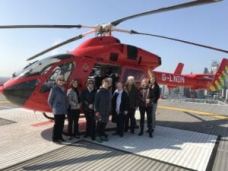 2022
2022 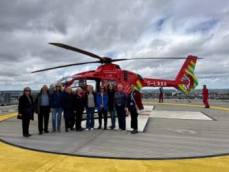 2026
2026
A typical day
In 2022, by the time we arrived at 11am, the crew had already been called out three times: to a cyclist, to a child hit by a car and to an accident on a construction site. For London’s Air Ambulance Charity, this was a typical day. Working 24 hours a day, serving the 10 million people who live within the boundaries of the M25, the team has saved thousands of lives.
When we visited in 2026, it was an unusual day and they hadn’t as yet been called. However, the klaxon did go whilst we were there and we saw the crew swiftly jump on board and leave to help.

London’s Air Ambulance Charity in numbers
Since its launch in 1989, London’s Air Ambulance has treated more than 52,000 patients. On average, the team treats 6 patients a day, and each mission costs approximately £3,466.
As a charity, London’s Air Ambulance relies heavily on public support. Without donations, it cannot continue providing this life-saving service.
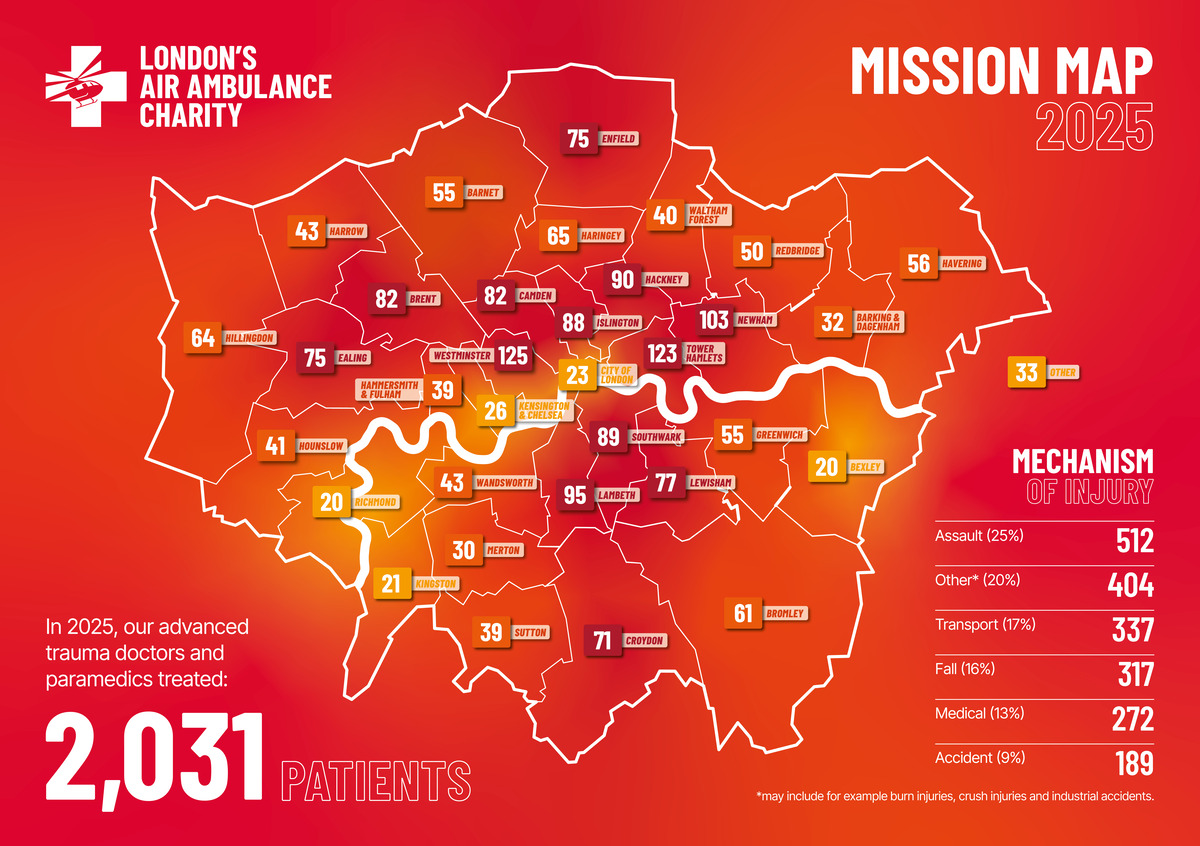

London’s Air Ambulance Charity
Most of us have seen the bright red helicopter speeding overhead to reach people with life-threatening injuries or medical emergencies. Therefore, it was fascinating to meet the people behind these rescues and learn more about the skills, expertise and logistics involved.

Pushing boundaries of expertise

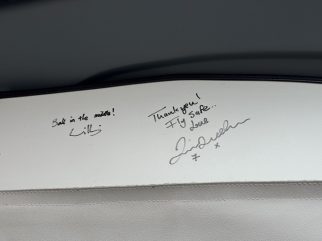
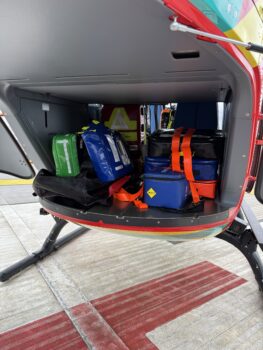
The signatures of Prince William and Sir David Beckham on back of the helicopter.
London’s Air Ambulance Charity crews are based at The Royal London Hospital in Whitechapel, east London. The service operates in partnership with the NHS through Barts Health NHS Trust and the London Ambulance Service.
However, as a charity funded largely through donations, it maintains a degree of independence from the NHS. This independence enables the team to push the boundaries of pre-hospital emergency medicine.
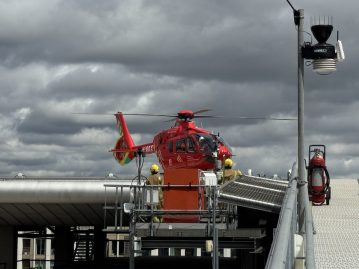
Leading the way in trauma healthcare
This degree of independence from the NHS allows London’s Air Ambulance Charity to lead the way in trauma healthcare worldwide. The team continually develops and refines techniques that improve outcomes for critically injured patients.
Sharing their knowledge
The team frequently publishes research papers based on its findings. Consequently, working within London’s Air Ambulance Charity has become one of the most sought-after roles for doctors and paramedics. Furthermore, specialist doctors from around the world visit the service to learn from its expertise and contribute their own knowledge and experience.

Operational hours
The helicopter operates from 8am until sunset throughout the year. During the night, rapid response cars deliver the advanced trauma team to critically injured patients, ensuring specialist care remains available 24 hours a day. There are always 2 teams available to cover the busy periods.

Firefighters on site
The helicopter pad has its own dedicated team of firefighters based at the Royal London Hospital. They remain on standby whenever the aircraft is operating and respond immediately to any fire-related incident. In fact, some of these firefighters are among the longest-serving members of the team.
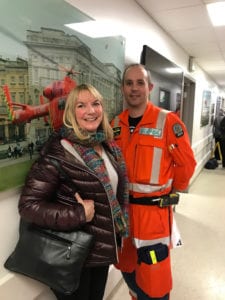
The crew
Each crew includes a doctor, a consultant and a paramedic seconded from the London Ambulance Service on a prestigious 12-month placement. Once on scene, they work closely with other emergency services personnel to provide the highest standard of care for the casualty.
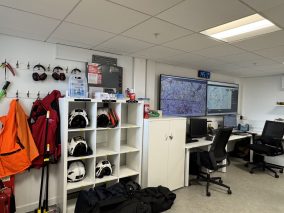
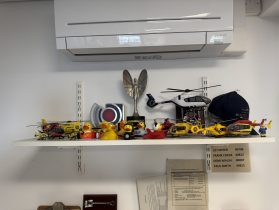
The control room – with screens showing all the other air ambulance crews across the UK, incident information and a full and detailed weather report.
Fly in, drive out
Interestingly, the helicopter rarely transports patients to hospital. Instead, its primary purpose is to get the specialist trauma team to the scene as quickly as possible. Following treatment, road ambulances usually transfer patients to the hospital best equipped to meet their needs. Only 4% of patients are flown back and this is usually if the helicopter has needed to go beyond the M25.
At night the helicopters are based at RAF Northolt.
Sometimes other air ambulance crews need to land at the Royal London in order to bring a patient there. If so, the London Air Ambulance helicopter and team will relocate and return once their helipad is vacant again.
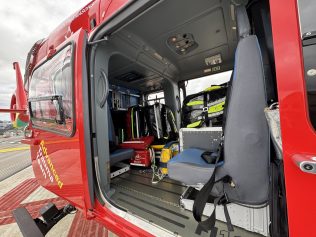
What kit do they carry?
The helicopter carries much of the equipment you would expect to find in an Accident and Emergency department – and more. The team carries units of O negative blood, along with advanced medical equipment designed to give patients the very best chance of survival at the scene.
Pioneering process
They were the first to perform pre-hospital, on-scene REBOA (Resuscitative Endovascular Balloon Occlusion of the Aorta). During this procedure, clinicians insert a cannula into the femoral artery and guide it into the lower aorta. They then inflate a balloon to temporarily stop blood flow below that point. As a result, they have been able to save people suffering catastrophic pelvic bleeding who previously would have died.
Cardiac support
The team is also beginning to explore the use of Extracorporeal Membrane Oxygenation (ECMO), sometimes referred to as Extracorporeal Life Support (ECLS) on scene.
This technique provides temporary external cardiac and respiratory support for patients whose hearts and lungs cannot function adequately on their own. By maintaining oxygen delivery and circulation, ECMO can sustain life while the team treats the underlying cause.
State of the art techniques
In addition, the team hopes to introduce roadside therapeutic cooling in the future. Slowing down the metabolic needs, protecting their organs, preventing brain damage and potentially saving even more people in some of the most extreme situations.

Learning experience
Every operation is a learning experience and an opportunity to further learn and improve for next time. Each time the team return from a mission, they instantly restock and check the kit and then group for a hot debrief. They go through the minutiae of each event and see when something went well, why it was good, and if something could have gone better to ensure they learn for next time. Later they will also meet to discuss the events in even more detail, looking further at the progress of the patients and how their intervention has impacted upon the patient’s recovery and prognosis.
Pre-hospital medicine is fast paced and spontaneous, all outcomes can be learnt from.
They also have a wealth of training aids on-site and utilise the time when waiting to be called, to upskill each other on the latest techniques.
Benefiting future casualties
Sadly, not all missions are successful, and the team receive reviews following post mortems to ensure they continue to learn and see if in hindsight there would have been anything further they could have done – for the benefit of future casualties.
Following up with patients
Patient Liaison team – are a group of highly qualified A&E nurses and integral part of the team. In addition, he is responsible for following up all patients who have been treated by London’s Air Ambulance Charity crew.
Casualties unaware they’ve been treated by the LAA crew
Their role is pivotal to their ongoing research and the innate sense of caring from the whole team. Many of the casualties are unaware that they were treated at the scene by one of London’s Air Ambulance Charity crew. They liaises with the patients, offer them ongoing support, referring them to relevant rehabilitation units and linking them to other patients for peer to peer support – particularly when they have experienced life-changing injuries.
Case studies
Their stories help London’s Air Ambulance Charity with case studies to help with their continual research and fundraising. These studies illustrate the reason for the air ambulance’s existence and how lucky we are to them. There are so many people who previously may well not have survived, have been given the chance to rebuild their lives and return to their families.
Royal Patron
Founded in 1989, the Duke of Cambridge became Patron of London’s Air Ambulance Charity’s 30th anniversary campaign which aims to highlight the charity’s vital work across the capital.
To find out more about London’s Air Ambulance Charity click here.
Written by Emma Hammett for First Aid for Life
Award-winning first aid training tailored to your needs
It is strongly advised that you attend a fully regulated Practical or Online First Aid course to understand what to do in a medical emergency. Please visit https://firstaidforlife.org.uk or call 0208 675 4036 for more information about our courses.
First Aid for Life is a multi-award-winning, fully regulated first aid training provider. Our trainers are highly experienced medical, health and emergency services professionals who will tailor the training to your needs. Courses for groups or individuals at our venue or yours.
First Aid for life provides this information for guidance and it is not in any way a substitute for medical advice. First Aid for Life is not responsible or liable for any diagnosis made, or actions taken based on this information.



0 Comments