
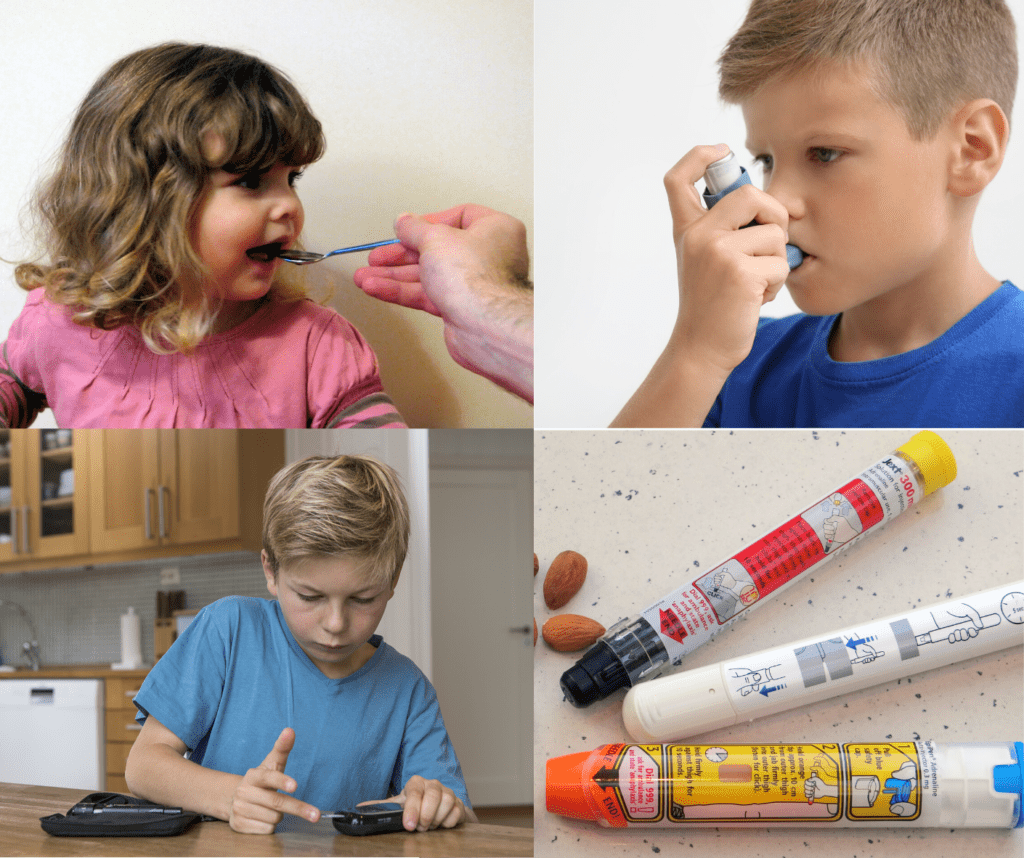
Children may require medication in schools routinely, occasionally or in an emergency.
It is vital that medication is only administered by staff appropriately trained and competent to give it. In addition, make sure to always give it according to written medical instructions and with written consent from the parent or legal guardian.
The Children and Family Act 2014 provides guidance for schools and professionals working with children. It explains how to keep to the legal requirements for giving medication in schools.
But, this article outlines just basic guidance for administering medication to children.
For full, in-depth training, you can complete our Supporting pupils with medical conditions and giving medication in schools and childcare settings course.
General advice for administering medication in schools:
Honest communication is essential. For instance, ensure that the child knows what to expect. In other words, always be honest; if the medicine is likely to taste bad, or an injection will hurt a little, let them know that is the case.
Clear instructions; the medication must be in the original container and be accompanied with clear prescribing instructions.
Records; similarly, it is vital to keep a written record of all medication administered; what was given, dosage, who by and when.
Hygiene; always wash your hands before administering medication.
You can also download our free ebook ‘Administering medicine in schools from everyday to emergencies’ as a quick reference guide
Giving liquid medication
Often liquid medication is easier to give to small children in a syringe; try to keep the child as calm as possible; hold them securely on your lap. In addition, it may be helpful to tuck one of their arms under yours.
- Shake the bottle; suck the appropriate dosage into the syringe.
- Wash the syringe carefully after use

Tablets and capsules
- Always give the tablets according to the written prescribing instructions.
- Have a glass of water ready for the child
- Encourage them to place the tablet or capsule at the very back of their tongue, tilt their head back and take a swig of water to wash the tablet down.
Do not assume it is okay to crush or break tablets: Some tablets or capsules are crushable. However, some tablets have a special coating to ensure they are absorbed at the best time; additionally, it may protect the delicate intestine from damage. Crushing these sort of tablets can cause serious harm. Therefore, tablets or capsules should only ever be crushed or broken if the pharmacy has advised that this is safe to do so. If not, leave the tablets whole.
Ear drops
Position the child into either of these positions, with the ear you are treating facing upwards:
- with the child’s head tilted back and to one side.
- with child flat on his or her back.
Administer the medication according to the written instructions.
Eye drops
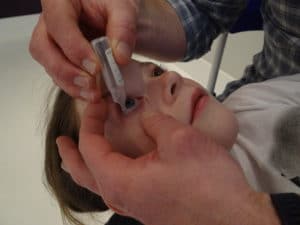
For administration of eye drops, position the child into either of these positions:
- tilt the child’s head back
- lay the child flat on his or her back, looking up at the ceiling.
Give the prescribed number of drops into each eye, using a different labelled dropper for each eye.
Eye ointment
Eye ointment is likely to be used for a short-term treatment. As a result, it is important to be aware of the expiry dates.These ointments are not long-lasting (often just 4 weeks).
Good advice is to lay the child flat on their back. As eye ointment is not easy to administer, for very young children, it may be easier for two people to do it. One to reassuringly hold the child, while the other administers the ointment.
Inhalers
In the event of an asthma attack, it is important to remain calm and reassuring. Panic can make an attack worse. Always follow the written prescribing instructions on the inhaler. It is the blue reliever you need in an asthma emergency. (Brown, green and other coloured inhalers are usually steroid based inhalers that control the person’s asthma. They also reduce the likelihood of them experiencing an attack).
If you support pupils with asthma, it helps to understand why triggers such as tree pollen and cold weather can make asthma worse.
In the absence of prescribing instructions, follow the following directions in an asthma attack:

Want a poster like this one? Browse our free collection of first aid infographics and posters.
Adrenaline auto-injectors
Adrenaline auto-injectors are used to administer adrenaline in case of an anaphylactic reaction. There are three different brands of auto-injector. The most common is Epipen, but Jext and Emerade autoinjectors are routinely prescribed too.
They all contain adrenaline and injection follows the same rules.

To administer an autoinjector:
- Hold the injector in your preferred hand. Remove the safety cap with the other hand .
- Put the injector firmly into the upper outer part of the casualty’s thigh and hold it there for 10 seconds. Or for new Epipen’s only 3 seconds.
- Remove the autoinjector.
- You should notice improvement within a few minutes.
- Therefore, if the child gets worse or there is no sign of improvement, you may need to give another injector.
- Bodies process adrenaline quite quickly, so the effects can begin to wear off within about 10 minutes. Call Emergency Services and be ready to give a second autoinjector if necessary.
You can use the auto-injector through clothes (avoid seams), as demonstrated here:

To better understand triggers and warning signs of anaphylaxis staff may find it useful to read more about food allergies and anaphylaxis.
To remember:
- Always phone an ambulance
Storage of Medication:
Appropriate storage and care of medicines:
Medication deteriorates if it goes out of date and you must store it correctly. In other words, it is vital that you keep to the storage instructions and abide by the expiry date.
Keep all medication in schools securely stored and out of reach of children.
Always follow the instructions on the packaging provided by the pharmacist.
For instance, discard eye drops according to instructions. Usually dispose of within 10 days of opening and store in the fridge.
First Aid Training
We strongly advise that you attend a fully regulated Practical or Online First Aid course. This will help you understand what to do in a medical emergency. Please visit First Aid For Life or call 0208 675 4036 for more information about our courses.
First Aid for Life is a multi-award-winning, fully regulated first aid training provider. Our trainers are highly experienced medical, health and emergency services professionals. They will tailor the training to your needs. Courses for groups or individuals at our venue or yours.
First Aid for life provides this information for guidance and it is not in any way a substitute for medical advice. First Aid for Life is not responsible or liable for any diagnosis made, or actions taken based on this information. Written by Emma Hammett.


0 Comments