
Main changes in Resuscitation Guidelines 2025
The main changes in the Resuscitation Guidelines 2025 are summarised in the sections below.
Education
The new guidance states that resuscitation education should begin early. Awareness campaigns should be tailored to diverse communities and resuscitation training introduced in childhood from age 4-6, continuing annually in schools.
It also recommends training in a really engaging manner, using hands-on training with mannequins, interactive training aids, games and scenarios. Training should be tailored to those attending, the environment in which they are working and relevant to the type of injuries that could happen.
Why this is so important:
Out-of-Hospital Cardiac Arrest (OHCA)
Around 115,000 OHCAs are reported to ambulance services annually, with resuscitation attempted in approximately 43,000 cases. Most cardiac arrests occur at home, in men aged over 65 (80% of them are due to a heart issue). Bystander CPR is provided in 60-73% of cases, though AEDs are only used in under 10% of these. A shockable rhythm is seen in 15-22%. ROSC (Return of Spontaneous Circulation) is achieved in about a quarter of these and 9-10% survive for 30 days. However, the ROSC is 50-57% with 30% surviving for 30 days in those where the person giving the CPR has received regular training and acted promptly and appropriately. Outcomes are poorer in deprived, urban, and ethnically diverse areas.
If someone collapses suddenly, people should always consider that they could have experienced a cardiac arrest.
Fortunately, Paediatric OHCA is rare, but theey do still happen – with around 750-800 cases each year.
Systems saving lives
The 2025 Systems Saving Lives guidance emphasises strengthening the chain of survival through advocacy, education, and system-wide coordination. It recommends mandatory CPR training for schoolchildren, students, and drivers, with annual training starting from age four and supported by technology-enhanced methods and community initiatives.
For schools, workplaces and families, our free ‘How to put someone into the recovery position’ wall poster is ideal to display alongside your first aid kit or AED. We also have numerous helpful posters covering all the key topics in first aid.
Bystander CPR and early defibrillation remain critical, doubling to quadrupling the chances of survival.

- The 2025 ERC BLS guidelines recommend calling the local emergency services for any person who is unresponsive. Rescuers no longer need to confirm abnormal breathing before calling 999. They should initiate the call first then assess breathing while waiting for the call to be answered. The calll handler will be able to assist in identifying abnormal breathing.
- Abnormal breathing can be difficult to identify. 30 – 60% of those in cardiac arrest will demonstrate some form of abnormal breathing, agonal gasps or seizure like activity.
- Exercise can sometimes lead to cardiac arrest. Immediately after the onset of cardiac arrest, athletes may still display a near normal or panting breathing pattern. They should be monitored closely and the rescuer should be ready to start CPR and use an AED if needed.
- For babies, children and adolescents you should start with 5 breaths and then give 15 compressions to 2 breaths.
- There is an update to AED pad placement.
Paediatric life support
The G2025 Paediatric Guideline emphasises the importance of early recognition of critical illness in children. Using structured tools and timely ABCDE assessment.
Triage Tools
In adults, out-of-hospital cardiac arrest is usually triggered by a primary heart problem, like a heart attack.
In children, however, the heart usually stops secondary to a progressive lack of oxygen (hypoxia), caused by airway/breathing problems, shock or neurological emergencies.
Therefore, the recognition and proper management of critically ill children remains the best way to prevent cardiac arrest.

Key updates include the addition of a new chapter on special circumstances in paediatric resuscitation. As well as the inclusion of post-resuscitation care tailored to children. These sections extend the chain of survival, emphasising reversible cause identification, context-specific management (such as trauma, asthma, drowning, and hypothermia), and structured follow-up after resuscitation to support recovery and outcomes. To learn more read our article The Paediatric Assessment Triangle – a Calm, Simple Guide.
We will produce more helpful downloads and infographics on this, so please look out for updates via email and subscribe to our newsletter.
You can also download our free ‘How to use an AED’ ebook and other life-saving first aid guides to help you stay confident between courses.
Important update to Paediatric CPR for those trained in Paediatric Basic Life Support
- For people attending a Paediatric Basic Life Support or Paediatric First Aid qualification, they will now be taught to give 5 rescue breaths and then give compressions at a rate of 15:2
- AEDs can be used on people of any age, including infants. Most infants don’t present in a shockable rhythm and so the AED would not shock. However, for an infant that is in a shockable rhythm they are likely to benefit from using an AED – even if only an adult AED is available.
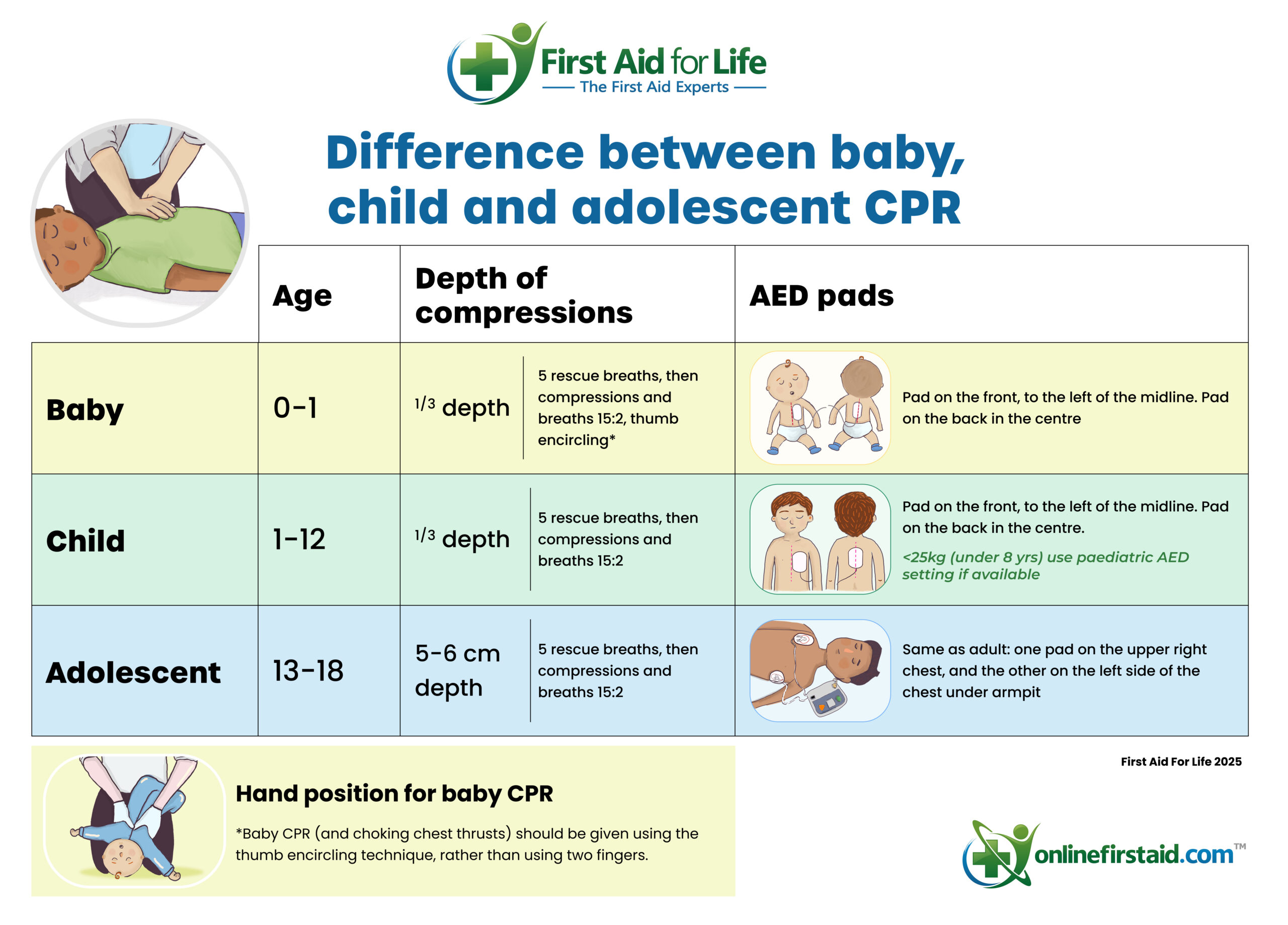
Change of hand position for baby CPR

Baby CPR (and choking chest thrusts) should now be given using the thumb encircling technique, rather than using two fingers.

AED Pad placement in children
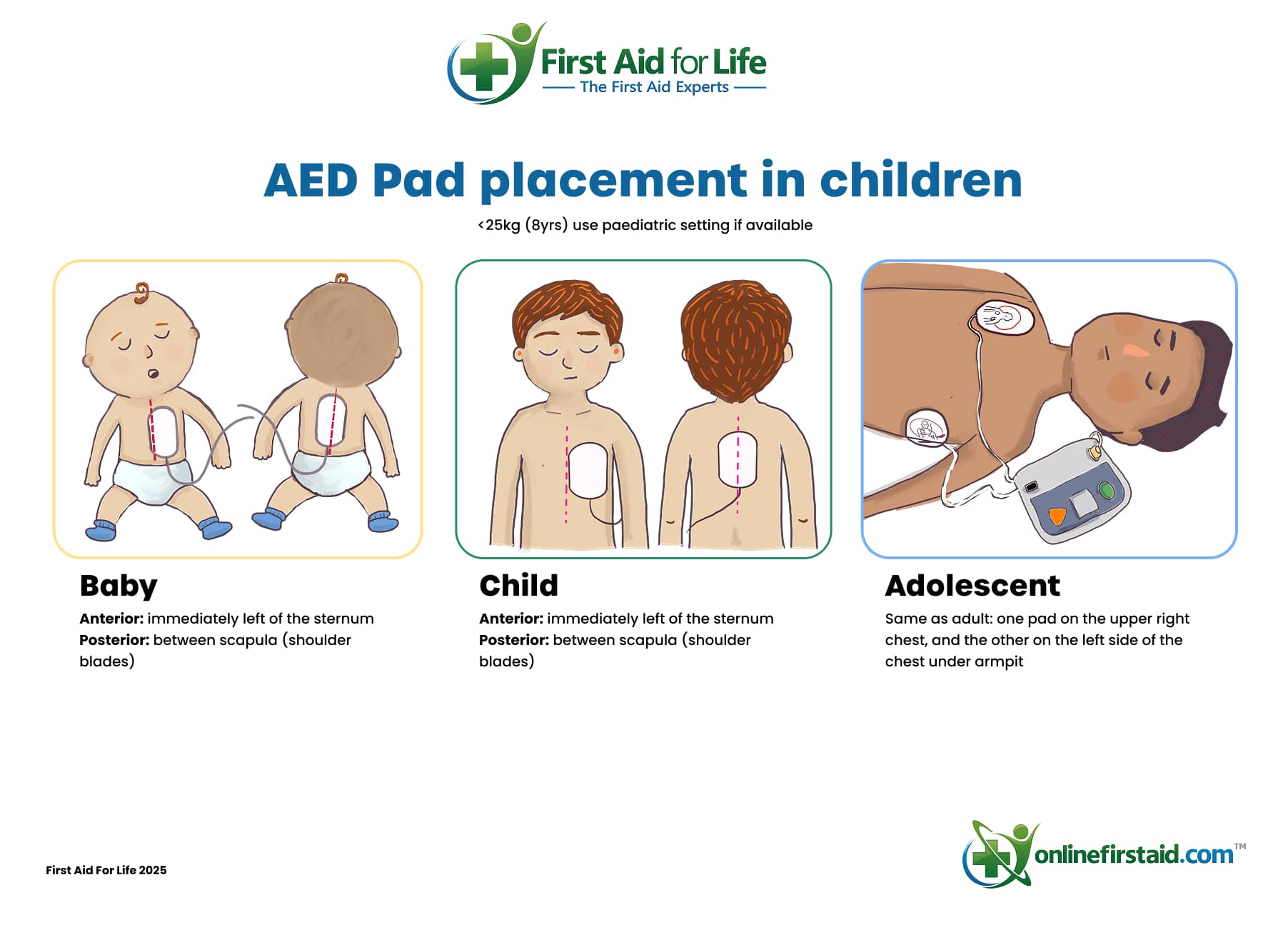
There is a tweak to the pad placement in children. It is now recommended that the pad on the front of their chest is placed just left of the midline of their chest and the pad on their back is placed in the centre of their back. The aim is always to try and place the pads so that they are either side of the heart’s ventricles.
Adult basic life support
The 2025 Adult Basic Life Support guidance reinforces that everyone can learn CPR and how to use an AED. The guidance stresses the importance of early recognition of cardiac arrest, calling 999, and starting chest compressions immediately.
New guidance advises calling 999 for any unresponsive person before assessing breathing, with ambulance service call handlers supporting recognition and CPR instructions.
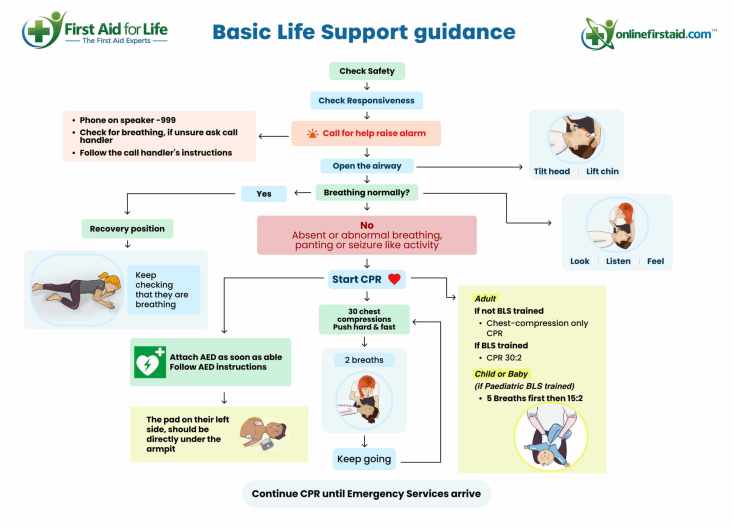
New CPR advice for adults
Chest compressions should be delivered at 100-120 min-1 to a depth of 5-6 cm, with minimal interruptions. Rescue breaths should be given if trained to do so. Untrained bystanders will be talked through chest-compression-only CPR by 999 call handlers. It is too difficult to explain how to open an airway and give breaths in the midst of a cardiac arrest situation. If you have been trained to give rescue breaths, please do so.
Breaths are important
Giving breaths remains important if trained to do so – the Eureka 2 study showed the following survival rates:
- 4.3% if no CPR was given
- 7.7% if chest compression only CPR was administered
- 13.6% if chest compressions and breaths were given
The role of ambulance service call handlers is highlighted, including their vital role, helping people to recognise breathing that is not normal, guiding callers through how to give CPR and use an AED, linking with volunteer first responder systems and advising as to the nearest AED.
Giving CPR on a bed

Previously giving CPR on a bed was discouraged as it wasn’t thought you could get deep enough compressions on a soft mattress. However, research using mannequins has suggested that it is better to give CPR on a bed, rather than delay trying to get someone off the bed and onto the floor. If giving CPR on a bed, remove the pillows and kneel beside them as this can help to counter the soft mattress.
AED pad placement
AED pads should be placed on an adult as shown on the pads. However, care should be taken to place the pad on the left hand side of the chest right under the armpit, not further down the side of the body.
Updates for Drowning
Drowning usually causes cardiac arrest following hypoxia, as the person has stopped breathing first. Consequently for drowning everyone will now be taught to give 5 rescue breaths first. Previously this adjustment was just taught to Life Guards,

First aid
The 2025 Resuscitation Guidelines introduce first aid as a brand-new chapter, recognising it as the essential first link in the chain of survival. The guidance defines first aid as help provided by anyone, in any situation, and emphasises early help, scene safety, and structured assessment using the ABCDE approach.
Clear expectations are set for first aiders:
- Call 999 promptly.
- Only use equipment or medicines you are trained to use.
- Prioritise reassurance and safety until professional help arrives.
Key medical emergencies are highlighted. These emergencies include choking, life-threatening bleeding, drowning, chest pain, asthma, anaphylaxis, hypoglycaemia, opioid overdose, stroke, and trauma, with simple stepwise interventions such as recovery position, tourniquets, adrenaline autoinjectors, and naloxone use where appropriate.
The new guidance also extends to environmental and situational emergencies 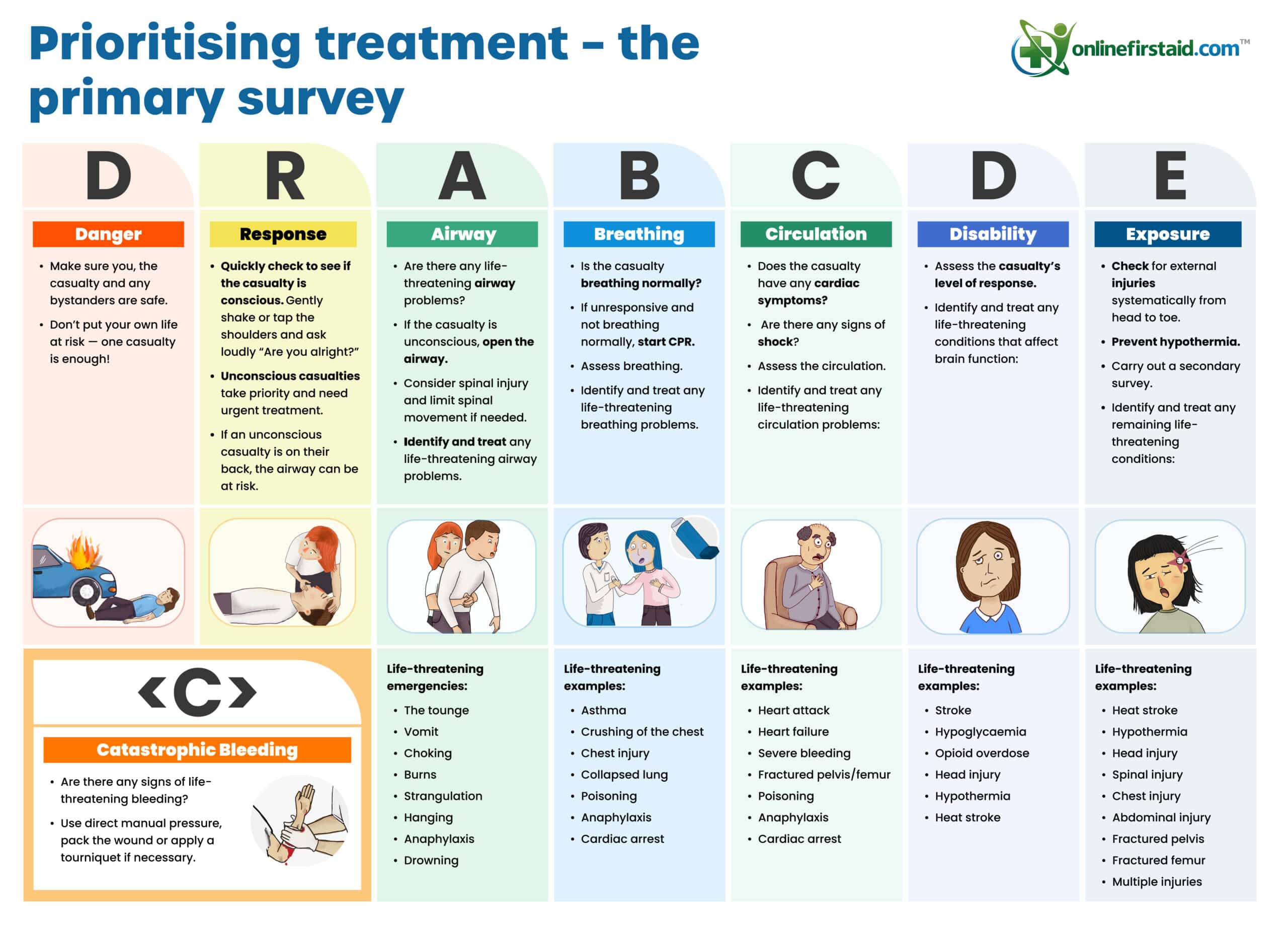 such as heat stroke, hypothermia, snake bite, and concussion.
Key updates
The first aid section adds Disability and Exposure to the usual ABC approach to the primary survey. So this is now the ABCDE approach. (This will be covered in a separate blog).
Life threatening bleeding is given a higher priority in the new guidance. It is likely this will be taught more routinely on first aid courses. Students will learn how to recognise a potentially catastrophic bleed, the importance of applying direct pressure first and if that is not sufficient moving swiftly to using a tourniquet or packing a wound. They will also learn how to improvise.
The Jaw thrust technique is likely to be introduced to the management of spinal injuries and taught on FAW courses.
Amputated parts
First aid for an amputated digit now recommends wrapping the body part in a cloth moistened with water, before placing it in a watertight bag or container on ice.
Hypoglycaemia
Hypoglycaemia is now listed as a condition requiring treatment not only for Diabetics, but for people who have prolonged fasting, are critically unwell, or have consumed excessive alcohol. For children who will not tolerate glucose gel (but are not unconscious), they can be given 1/2 a teaspoon of ordinary sugar under their tongue.
Anaphylaxis
For someone experiencing anaphylaxis it is now recommended that if a second adrenaline autoinjector is needed, that it is given in the opposite leg to the first injection. This is because adrenaline is a powerful vasoconstrictor and injecting twice in the same leg may not be as effective.
If you are using a neffy adrenaline nasal spray, then you give a second dose in the same nostril.
Future iterations
This new guidance reinforces that everyone has a role in saving lives. Embedding first aid as an integral part of the UK’s resuscitation framework.
It is intended that the Resuscitation Council UK Guidelines will only change within the five-year cycle if there is a significant resuscitation intervention identified through the ILCOR process which affects outcome to a significant degree. These Guidelines 2025 will be implemented in courses from January 2026.
Choosing your first aid training provider:
First Aid for Life is a multi-award-winning and fully regulated first aid training provider. Our trainers are highly experienced medical, health and emergency services professionals who will tailor the training to your needs. They always go the extra mile to ensure you have a top quality, enjoyable and relevant first aid course.
First Aid for Life is fully regulated through Qualsafe Awards and is regularly inspected to ensure we operate to the very highest standards.
Our courses are EYFS, Ofsted, Ofqual and HSE compliant.
How we can help:
First Aid for Life can come to your workplace or home, or individuals can attend our open courses in London. For blended learning, the online element consists of videos, step by step directions, infographics and test yourself sections. Students can stop and start as often as they like and it is fully compatible with all devices. Practical courses are face to face with mannequins and numerous other engaging training aids to ensure courses. All our Paediatric First Aid Courses include Emergency Life Support, Choking and Anaphylaxis (using an EpiPen or Jext). As well as covering the full EYFS syllabus. To ensure you’re fully confident with the latest Resuscitation Council 2025 guidance in practice, our CPR, AED, recovery position and choking first aid course gives you hands-on practice with the exact skills that save lives.
All our training will be up to date with all the very latest guidance.
To book a group course with us please email emma@firstaidforlife.org.uk. To book individuals onto our open courses please visit our scheduled dates.
References
ERC Guidelines 2025
International Liaison Committee on Resuscitation Consensus on Science and Treatment Recommendations
European Resuscitation Council Guidelines 2025 Adult Basic Life Support
European Resuscitation Council Guidelines 2025 Education for Resuscitation



I appreciate the update and the clarifications.
This line on New CPR advice “Chest compressions should be delivered at 100-120 min-1 to a depth of 5-6 cm,” what does 100 – 120 min-1 mean?
I am so sorry, that was a typo and I have just removed it.
I love reading your posts Emma, the details are explained in a easy way to follow. As I don’t teach first aid as often anymore and work more in health and safety these days, I find your updates so helpful. Thank you.
This was really useful information Emma, the video made everything very clear. Thank you for outlining the changes.
Great blog on first aid training! Being prepared to act quickly in emergencies can truly save lives. Awareness and practical skills like these are essential for safer workplaces and communities.
I have just found this site, really well laid out and clear information. My only question is about “Abnormal breathing can be difficult to identify. 30 – 60% of those in cardiac arrest will demonstrate some form of abnormal breathing, agonal gasps or seizure like activity”.
The seizure like activity part. It reads like you would suggest starting compressions on someone having a seizure. Could you offer some clarity?
When someone experiences a reduction in oxygen to the brain it can cause them to experience seizure-like activity. If you are caring for anyone experiencing a seizure it is vital to check they are breathing normally once the seizure finishes as the seizure may have been caused by a cardiac arrest. If they remain unresponsive and are not breathing normally then you should start CPR. If they are breathing normally, but remain unresponsive, then put them into the recovery position. There are many causes of seizures, cardiac arrest is one of them. It is vital to check their breathing and start CPR as soon as possible if they are not breathing normally.