
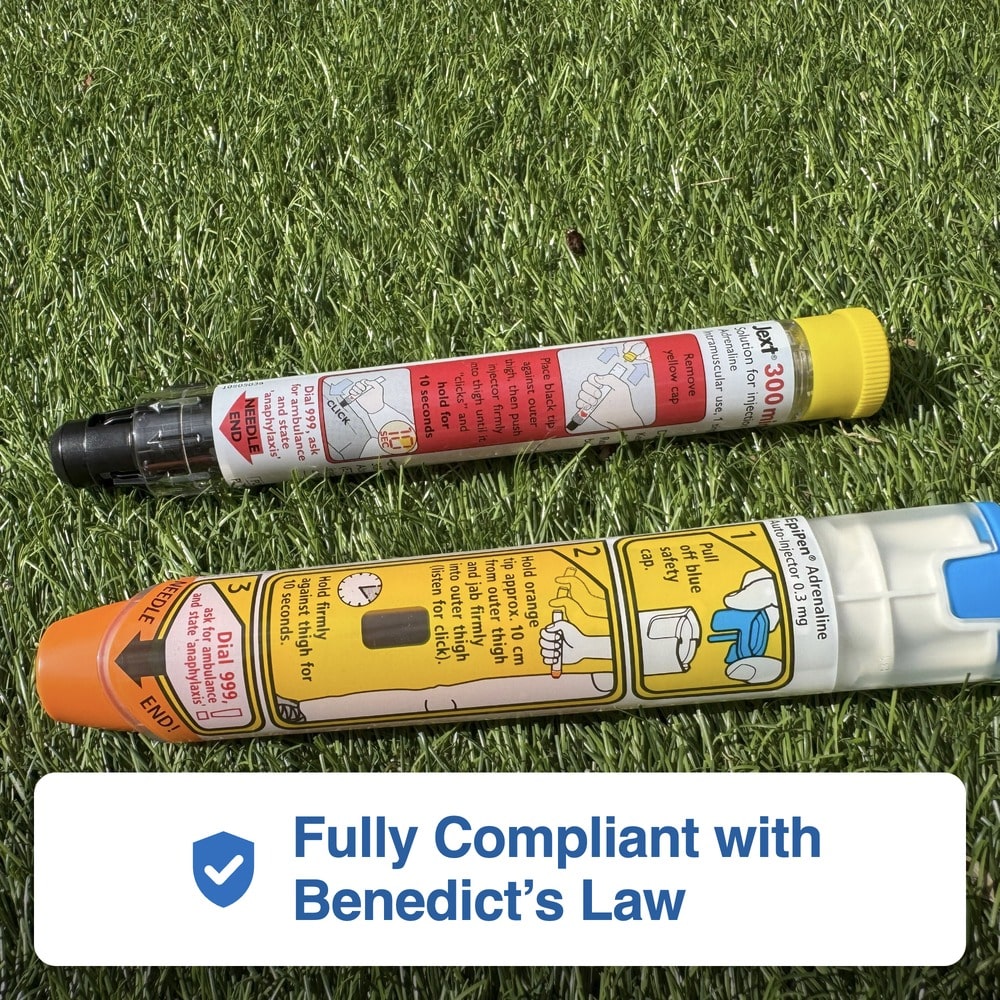
Allergy Awareness and First Aid for Anaphylaxis – Compliant with Benedict’s Law
Accredited training with the UK's leading first aid provider.
included
Original price was: £58.80.£12.00Current price is: £12.00. (inc. VAT)
Allergy Awareness and First Aid for Anaphylaxis - Compliant with Benedict's Law
Course Overview
Anaphylactic Shock and Acute Allergic reaction
Fully updated and compliant with Benedict's Law and the latest Government legal requirement for managing medical conditions in schools. Mapped to the Department of Education DfE 12 learning outcomes.
Anaphylactic Shock is a life threatening reaction that can happen very quickly and needs to be recognised and treated immediately.
This course is designed for all staff who need to comply with Benedict's Law, it is also suitable for anyone who has suffered an acute allergic response, who are at risk of experiencing an anaphylactic reaction, a parent of someone who has experienced an anaphylactic reaction, health professionals giving routine vaccinations or professionals such as dentists and aesthetic practitioners using products someone could react to. It is specifically written for teachers, Nursery workers and carers in a school setting.
This course is designed to give you the knowledge to identify and help someone experiencing an anaphylactic reaction. In addition to the core topics, it includes the difference between allergies, intolerances and coeliac disease and other co-existing conditions, it explores the impact of anaphylaxis on a child's wellbeing and has helpful topics to help schools implement their allergy action plan - along with a short workbook to consolidate this.
This course does not seek to replace a practical course but allows you to learn these vital skills in a comprehensive way, at a time and place to suit you.
Course Features
The course consists of illustrated step by step directions, flow charts, diagrams, videos and test yourself sections fully compatible with all computers and mobile devices. You will be able to stop and start as often as you like and print your Certificate on completion. This course should take around 1 hour and you will have continuous access to the course for 12 months.
Important Information
It is impossible to cover all eventualities within this course, or to equip you with the knowledge and skills to appropriately diagnose and treat in unpredictable real life situations. If you suspect serious illness or injury, you should always seek immediate professional medical advice. The Author has made every effort to ensure the accuracy of the information contained within the course, however this course is merely a guide and the Author does not accept any liability or responsibility for any inaccuracies or for any mistreatment or misdiagnosis of any person, however caused.
About the Author
The course material has been written by Emma Hammett, Qualified Nurse, First Aid Trainer and founder of First Aid for Life in conjunction with other medical and first aid professionals. If you have any queries concerning this course, please contact emma@firstaidforlife.org.uk
Course Contents
Allergy Awareness and first aid for Anaphylaxis:
Complete course content mapped to the twelve DfE training outcomes
Module 1
Have an awareness of allergy, the risks it poses, how allergic reactions can occur and how to manage it
Module 2
Understand that allergy includes multiple conditions — food allergy, asthma, eczema, hay fever and others — which can co-exist
Module 3
Understand the difference between food allergy, coeliac disease and food intolerance
Module 4
Know where to find information on allergy triggers
Module 5
Can identify the range of symptoms of allergic reactions
Module 6
Understand and can recognise anaphylaxis
Module 7a
Know how to respond in an emergency: calling emergency services and informing parents
Module 7b
Know how to respond in an emergency: how to locate and administer emergency medication
Module 7c
Know how to respond in an emergency: how to use the medication or device
Module 8
Understand the impact allergy can have on a child or young person’s wellbeing
Module 9
Understand the school, college or setting’s allergy safety policy
Module 10
Know how to check whether an individual is on the record of those with known allergy, and how to use an Allergy or Asthma Action Plan
Module 11
Understand their responsibilities in reducing the risk of individuals with known allergy coming into contact with their known allergens
Module 12
Understand how to report an allergic reaction or case of anaphylaxis, whether an incident or a near miss
Completion workbook
Test Yourself Section