
What to do right now:

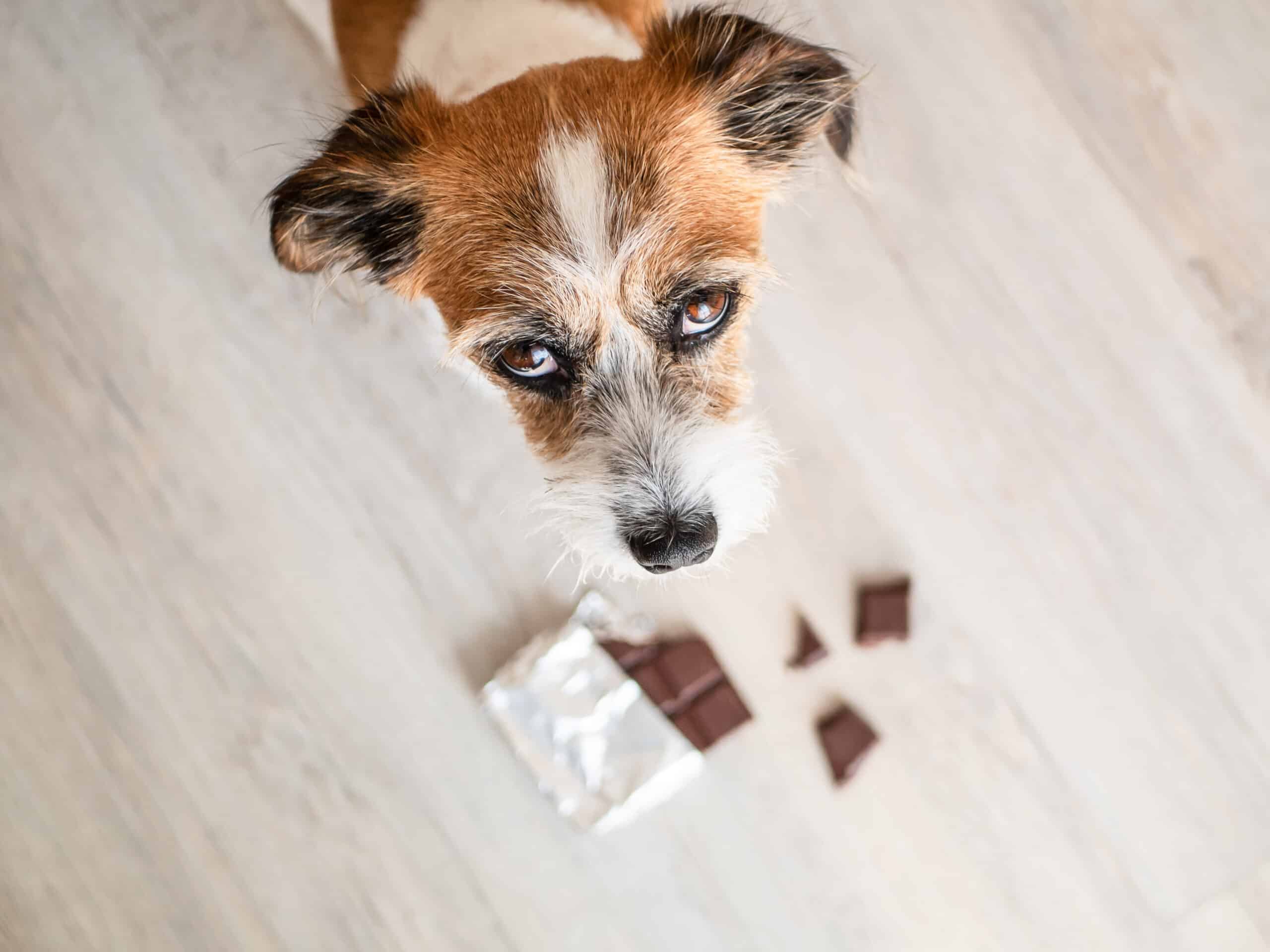
Is chocolate dangerous for dogs?
Different dogs react to different things. Some dogs can tolerate human chocolate without any apparent ill effects. Other dogs will react very badly to certain foods and for some and it could kill them.
Dogs are masters at sniffing out chocolate and have been known to go to extreme lengths to access this tasty treat. Don’t imagine that just putting it out of reach is sufficient because if they want it, they will do their best to get it!
However, chocolate (particularly dark chocolate) can be extremely dangerous for dogs. Chocolate is the cause of death for numerous pets every year.
Chocolate contains a stimulant called Theobromine, which is similar to caffeine and is poisonous to dogs. Vets say that chocolate is one of the most common causes of poisoning in dogs. Not only can it make them extremely unwell, but it can also, in some cases, be fatal. Different types of chocolate contain different amounts of Theobromine. For instance dark chocolate contains the most, while white chocolate has very little. Despite this, it is still important to be aware of the risks.
Signs and symptoms of chocolate poisoning in dogs:
If my dog has snaffled my chocolate – what will the Theobromine do and what symptoms will I see?
Theobromine primarily affects the heart, central nervous system and kidneys. Symptoms will occur from 4-24 hours after your dog has eaten chocolate and will vary depending on the amount of chocolate (Theobromine) your dog has eaten.
Symptoms you may see:
- Vomiting (possibly including blood)
- Diarrhoea
- Hyperactivity and restlessness
- Rapid breathing
- Muscle twitching
- Increased heart rate
- Seizures / fitting
What the vet will do and first aid:
If your dog has eaten any chocolate contact your vet as quickly as possible. Be prepared to provide details about the amount consumed and the type of chocolate. Save any wrappers or remains and take them with you to the vet.
Unfortunately, no antidote exists for Theobromine. In most cases, vets induce vomiting, wash out the stomach, and administer activated charcoal to absorb remaining Theobromine. However, do not attempt to make your dog vomit yourself, as this should only be done by a vet in a controlled environment.
Please note that not all pets react to the same way to toxic foods. Some appear to tolerate grapes, raisins, chocolate etc. with no apparent ill- effects. There is no way to predict the effect foods will have on your dog and so it is always safest to avoid them entirely.
If you suspect your dog has eaten chocolate, even if they do not appear to be having any adverse reaction, always contact your vet for their advice. Your dog’s survival often depends on how quickly you act. Symptoms of poisoning can take hours or even days to appear, and by then, it might already be too late.
Free Online First Aid Course for Dogs
Try our free coure to learn how to help your dog if they start choking. Essential knowledge for all dog owners.
Frequently asked questions
What should I do if my dog eats chocolate but seems fine
Call your vet for advice. Symptoms can appear hours later. The risk depends on your dog’s size, the type of chocolate, and the amount eaten.
How long after eating chocolate do symptoms show
Often between four and twenty four hours, sometimes sooner. Keep a close eye and follow your vet’s guidance.
What should I do if my dog eats chocolate cake
Cake can still contain cocoa or chocolate. Treat it seriously. Call your vet with the ingredients and how much was eaten.
Is there a safe amount of chocolate for dogs
No amount is considered safe. Dark chocolate contains the most Theobromine, white chocolate has very little, but it is best to avoid all chocolate.
Should I try home remedies or make my dog sick
No. Do not try home remedies and do not make your dog vomit unless a vet tells you to.
Who should I contact in the UK
Your local veterinary practice or an emergency vet clinic. Provide your dog’s weight, the type of chocolate and the amount eaten.
What should I do if my dog eats chocolate biscuits
Treat it as chocolate. Call your vet with the brand and the amount eaten. Keep any packaging and follow their advice.
How serious can chocolate poisoning be
It can be life threatening, especially with dark chocolate and in small dogs. Call your vet at once. The faster the treatment starts, the better the outcome.
Chocolate Toxicity Calculator
If you’d like to understand how much chocolate could be dangerous for your dog, the MSD Veterinary Manual has an excellent free Chocolate Toxicity Calculator. It helps you estimate risk based on your dog’s weight and the type of chocolate eaten.
Always remember, it’s a guide only. If your dog has eaten any chocolate, please contact your vet straight away.
About us
First Aid for Pets provides this information for guidance and it is not in any way a substitute for veterinary advice. The author does not accept any liability or responsibility for any inaccuracies or for any mistreatment or misdiagnosis of any person or animal, however caused. It is strongly advised that you attend a practical First Aid for Pets course or take our online course to understand what to do in a medical emergency.
Onlinefirstaid.com has a wealth of award-winning online first aid courses – enabling you to learn these vital skills at a time and place to suit you.
Please contact emma@firstaidforpets.net or https://firstaidforpets.net
About us
First Aid for Pets provides this information for guidance and it is not in any way a substitute for veterinary advice. The author does not accept any liability or responsibility for any inaccuracies or for any mistreatment or misdiagnosis of any person or animal, however caused. It is strongly advised that you attend a practical First Aid for Pets course or take our online course to understand what to do in a medical emergency. Onlinefirstaid.com has a wealth of award-winning online first aid courses – enabling you to learn these vital skills at a time and place to suit you. Please contact emma@firstaidforpets.net or https://firstaidforpets.net




0 Comments