
Emma Hammett provides advice for dental professionals, incorporating updates from the Resuscitation Council UK’s 2025 Resuscitation Guidelines.
A patient could collapse on any premises at any time, whether they have received treatment or not. It is therefore essential that ALL registrants are trained in dealing with medical emergencies. Including resuscitation, and possess up to date evidence of capability.
Cardiorespiratory arrest is rare in primary dental practice. However, there is a public expectation. That dental practitioners and all other dental care professionals should be competent in treating cardiorespiratory arrest.
Dental staff’s knowledge and skills in resuscitation should be updated at least annually.
Accurate documentation of any patient’s medical history should allow most people at risk of certain medical emergencies and subsequent cardiorespiratory arrest to be identified in advance of any proposed treatment.
- Dental practitioners and other dental care professionals must be trained in cardiopulmonary resuscitation (CPR) so that in the event of cardiorespiratory arrest occurring they can:
-
Recognise cardiorespiratory arrest
-
Summon help immediately (dial 999)
-
Start CPR, using chest compressions and providing ventilation with a pocket mask or bag-mask device and supplemental oxygen. (Evidence suggests that chest compressions can be performed effectively in a fully reclined dental chair)
-
Attempt defibrillation (if appropriate) within 3 minutes of collapse, using an AED
-
Provide other advanced life support skills if appropriate and if trained to do so.
- Dental practitioners and other dental care professionals who work with children should learn the differences in CPR (from CPR in adults) for use in children and practise these on paediatric manikins.
- Dental practitioners and other dental healthcare staff should update their knowledge and skills in resuscitation at least annually.
- A system must be in place for identifying which equipment requires special training. Such as AEDs, bag-mask devices and oropharyngeal airway insertion. As well as for ensuring that such training takes place.
- All new members of dental staff should have resuscitation training as part of their induction programme.
- Training and retraining should be a mandatory requirement for Continuing Professional Development and maintenance on professional healthcare registers. It may be appropriate for some retraining to be undertaken using ‘e-learning’.
- In the event of cardiorespiratory arrest, emergency services should be summoned immediately by calling 999. A local protocol should include clear directions on how to find the dental care facility and whether or not there may be a difficult access point. Primary dental care practices should identify clearly all access points and patient removal routes.
- Ambulance personnel will provide equipment, expertise, practical help and a range of treatments supplementary to those available in the dental surgery.
- Written documentation containing details of the dental procedure, (If any), medical emergency, any treatment given, and the name of the Dental Practitioner should all accompany the patient to hospital.
- Relatives or carers should be informed about the transfer of a patient but should not expect to travel with the patient in the ambulance. Contact details should be obtained by the ambulance personnel.
Automated external defibrillator (AEDs)
It is recommended that all dental practices should have immediate access to an automated external defibrillator (AED). AEDs are suitable for use in adults and in children over eight years of age. Some AEDs can be modified eg use of paediatric pads/connection. To increase their suitability for use in children between one and eight years of age; dental practices that treat children regularly should consider purchasing this modification for their AED.3 If this modification is not available, the standard AED can be used in a child over one year of age.
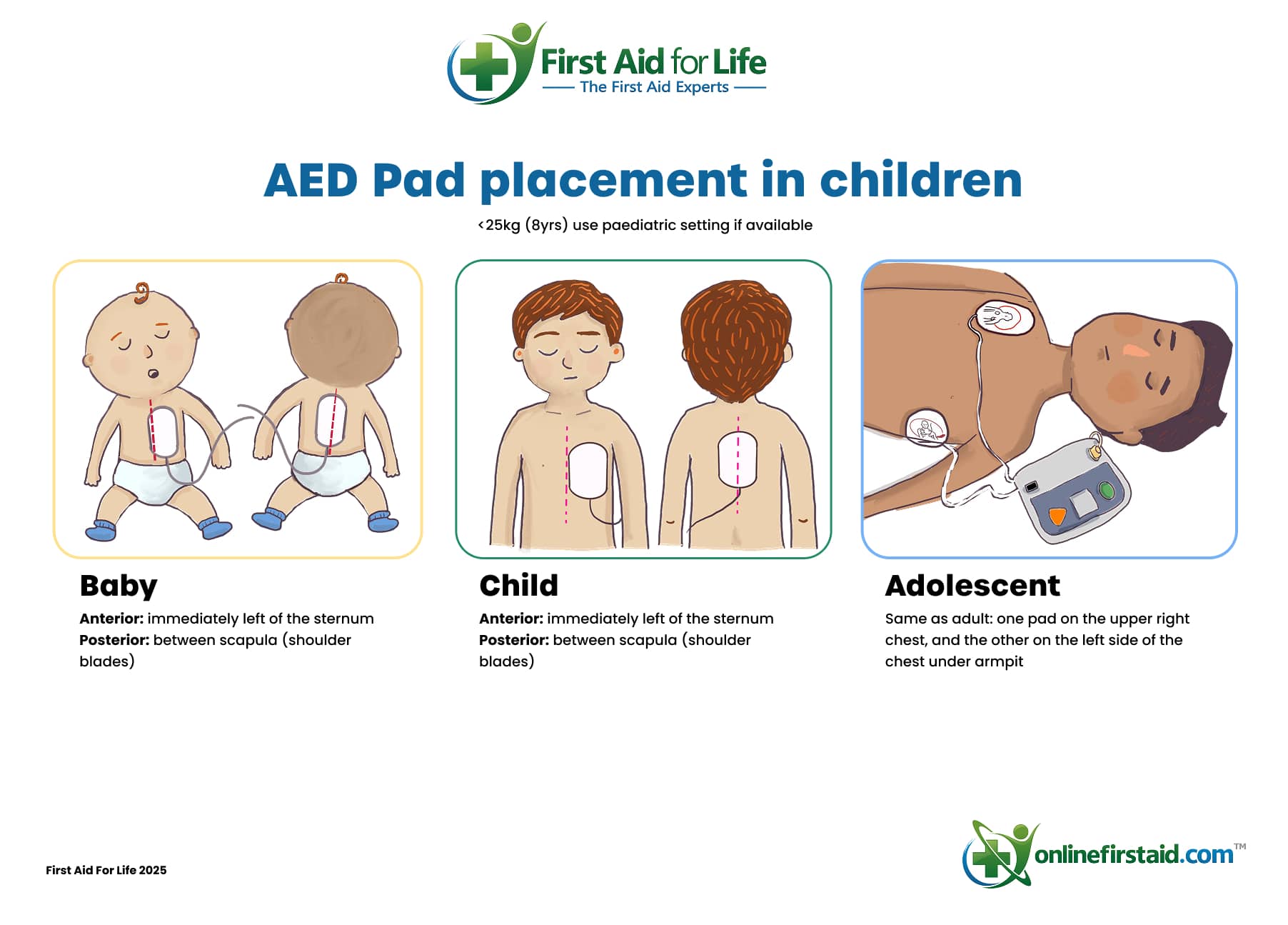
General Dental Council ‘Scope of Practice’ and Resuscitation Council UK guidance 2025
If a casualty appears to be unconscious, there is a clear protocol as to what to do, beginning with the Primary Survey:
The Primary Survey
The Primary Survey is a fast and systematic way to find and treat any life-threatening conditions, in order of priority. It has been covered in the first part of this series of articles along with detailed instructions concerning the Recovery Position.
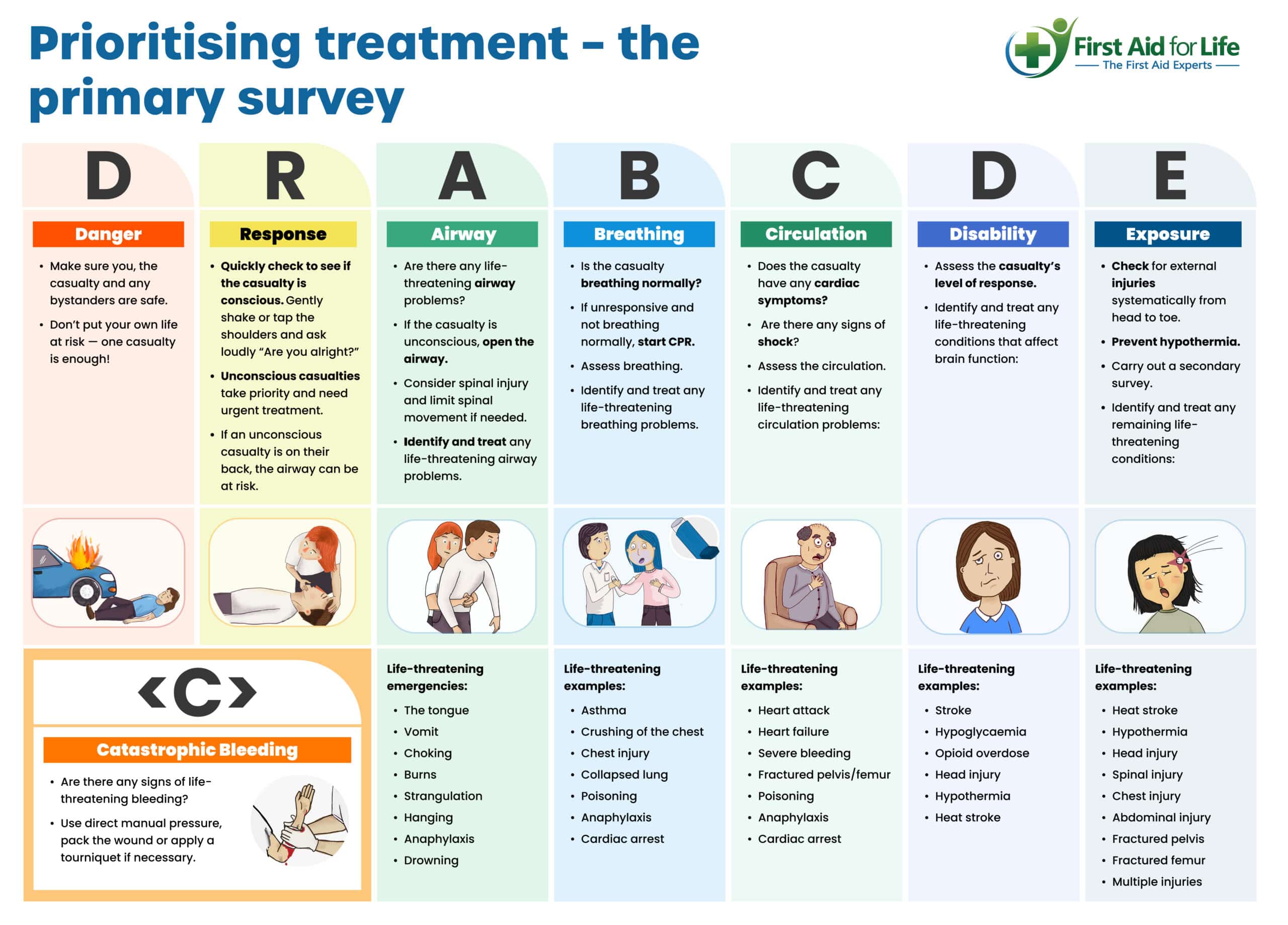
- Remove Danger
- Check for Response
- Open the Airway
- Check for Breathing (start CPR if they are not breathing)
- Access circulation
- Identify and treat any life-threatening condition that affect brain functions • Check for external injuries and carry out the secondary survey.
If they are unconscious and breathing properly – at least 2 normal breaths in a 10 second period; then put them in the recovery position.
Not breathing normally
If they are not breathing normally or you are unsure – start CPR
Just after their heart ‘stops’, a casualty may appear to be ‘breathing’ when they are not. These breaths are called “agonal gasps” and are a reflex action from the lungs and are not effective breathing. If there are less than 2 breaths in a 10 second period, or the person is breathing very strangely, they are not likely to be breathing sufficiently. You should start CPR.
If in doubt always start CPR – it is better to have tried to resuscitate someone unnecessarily than not to resuscitate someone that really needs it.
When you are resuscitating someone, you are being a life support machine. When you push on their chest – you are being their heart and when you breathe into them – you are being their lungs. You are keeping their heart and brain full of oxygenated blood and keeping them alive. Using the defibrillator early dramatically increases their chances of survival.
When an adult collapses and is assessed as unresponsive and not breathing; they are likely to still have residual oxygenated blood remaining in their system. However, their heart is no longer working effectively. Therefore important to quickly circulate the oxygenated blood in their system. To sustain the blood supply to their heart and brain. By pushing hard and fast on their chest.
- Push hard and fast on the centre of their chest
- Push down 5-6 cms –
- At a rate of 115 – 120 beats per minute – roughly 2 per second
- do 30 compressions then…
To give someone the best chance, you will need to:
- Tilt the head and lift the chin to take the tongue off the back of the airway, hold their nose,
- Give 2 breaths – sealing your mouth around their mouth and blowing into them like a balloon.
Make sure their chest rises each time – if it doesn’t – try tilting the head a bit more. If it still doesn’t rise go straight back to the compressions.
Research has shown that it takes around 10 -12 compressions to reach sufficient pressure to get the blood circulating to the heart and brain, this is why it is advised that you do 30 compressions and then 2 short breaths to top up their oxygen.
Use a face shield or pocket face mask to protect yourself.
If you are trained in the use of airway adjuncts and a bag and valve mask this is preferable to mouth to mouth.
Keep going
You are being a life support machine and keeping them alive. When you push on the chest – you are being the heart
When you breathe into them – you are being the lungs
Do not expect them to come back to life until the paramedics are there to help. Therefore, don’t stop to check for signs of life, just keep going, unless it is very obvious that there are signs of life.
USE your AED machine as soon as possible! Deploying an AED within 3 minutes, if someone is unconscious, not breathing and in a shockable rhythm – has been shown to increase the
chances of survival from 6% to 74%. For every minutes’ delay over that 3 minutes, the chances decrease by 10%. Ensure everyone in the Practice knows where the AED is kept and how to use it.
If there is someone to help, do cycles of compressions and breaths and swap every 2 minutes. One person should be responsible for the compressions and the breaths (unless you are using a bag and valve mask) – you should give 30 compressions to two breaths.
When swapping compressions, aim to minimise the time when no one is pressing on the chest. Therefore, when the 30 compressions have been completed, the person swapping out should complete their 2 breaths, whilst the person taking over gets into position to commence the chest compressions. Swapping every 2 or 3 minutes will maximise the effectiveness of the chest compressions and give time for those giving the compressions to recover before recommencing. CPR is hard work!
If you are using a BVM ensure you are squeezing steadily and not over ventilating them.
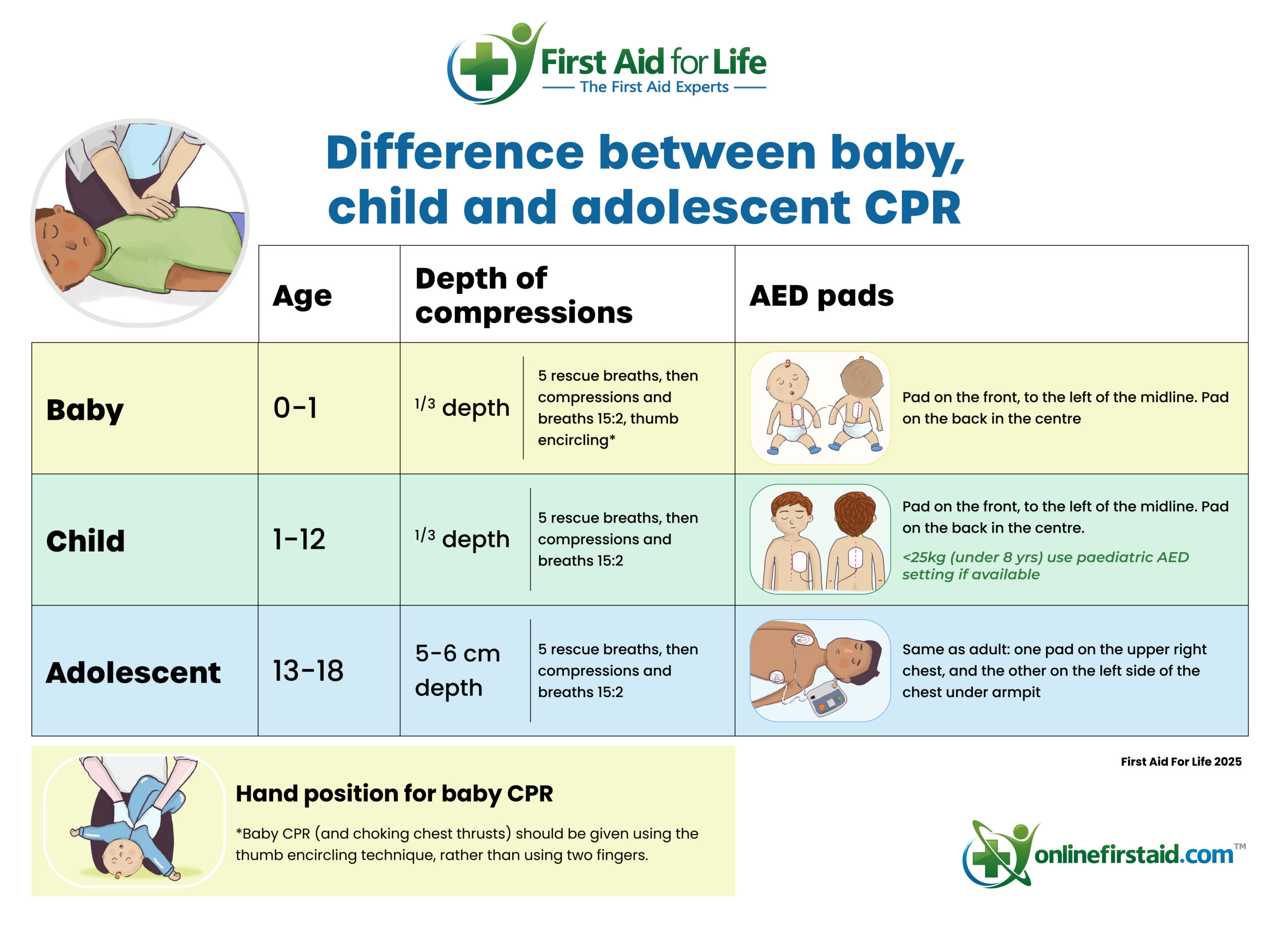
For a child or baby
Do 5 Rescue breaths before you start compressions and phone an ambulance if on your own, after completing one minute’s CPR.
- You start with 5 rescue breaths to re-oxygenate them as children do not retain residual oxygen in their system as adults do. It is also far more likely that they have experienced a respiratory arrest.
Carefully tilt the head and lift the chin (to a sniffing position for a child and horizontal for a baby) to open the airway, then give 5 rescue breaths to re-oxygenate them.
(DO NOT TILT A BABY’S HEAD TOO FAR BACK– just to horizontal is sufficient – over extending a baby’s airway can occlude it)
- For a baby, seal your mouth around their mouth and nose if you can fit your mouth over both and blow into them gently with a puff of your cheeks.
For a child you can blow a little harder. Just enough to inflate their lungs. If you over-inflate them you will fill the stomach with air, which can displace its contents. Be ready with suction if they begin to gurgle.
You will then need to circulate the oxygenated blood by pushing down hard and fast on their chest.
For a child, use one hand.
For a baby use two thumbs one on top of the other.
- Push hard and fast on the centre of their chest – roughly between the nipples.
- Push down by a third of the depth of their chest.
- At a rate of 110 -120 beats per minute – roughly 2 per second.
After about 15 compressions…you will need to give them 2 more short breaths and then continue with the compressions again. 15:2:15:2:15:2…
When to phone an ambulance if you are on your own:
If you are on your own, you should perform a minute’s CPR before phoning for an ambulance (5 breaths, then three cycles of 15:2 is about a minute).
For an adult phone for an ambulance as soon as you realise that they are unresponsive and not breathing.
If there is someone else available, they should call for an ambulance as soon as it is established whether or not the person is breathing. It they are not breathing, get the defibrillator immediately.
When to stop:
You should stop CPR if the casualty starts breathing normally.
If you are too tired to continue.
When the paramedics have taken over.
Whilst the defibrillator is analysing the heart rhythm and if a shock is advised. Be ready to recommence as soon as the shock has been given.

Written by Emma Hammett for First Aid for Life
It is strongly advised that you attend a fully regulated Practical or Online First Aid course to understand what to do in a medical emergency. Please visit firstaidforlife.org.uk or call 0208 675 4036 for more information about our courses.
If they are not breathing normally
First Aid for Life is a multi-award-winning, fully regulated first aid training provider specialising in first aid and medical emergency training for Dental Practices. Our trainers are highly experienced medical, health and emergency services professionals who will tailor the training to your needs. Courses for groups or individuals at our venue or yours. We have specific online first aid courses for dentists available on www.onlinefirstaid.com that are ideal for your verifiable, enhanced CPD.
First Aid for life provides this information for guidance and it is not in any way a substitute for medical advice. First Aid for Life is not responsible or liable for any diagnosis made, or actions taken based on this information.



0 Comments