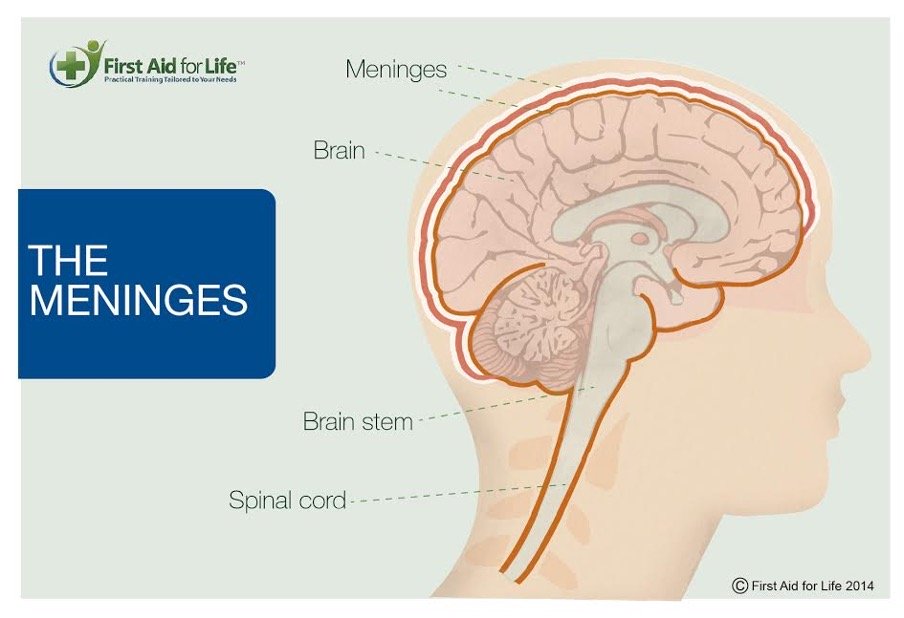
Meningitis is swelling of the meninges (the protective membranes of the brain and spinal cord). The inflammation is usually the result of an infection.
Causes
Meningitis is inflammation of the lining of the brain and spinal cord and can result from multiple causes, including sepsis. However, it is often spread by a bacteria or virus that can live in the nose or throat in some people, without causing any illness. Consequently, actions such as kissing, sneezing or coughing can easily spread it.
While Viral meningitis can be very unpleasant, it is rarely life threatening and most people eventually make a full recovery.
However, Bacterial meningitis is more serious and often life-changing or fatal.
Recognising meningitis can be hard as early symptoms are similar to flu and other common illnesses
Additionally, people who host the bacteria or virus in the back of their noses or throats are asymptomatic, meaning they don’t know that they’re spreading it. Therefore it’s crucial for those in this, at risk group, to be protected against it with a vaccine.
Symptoms of Meningitis (and Sepsis)
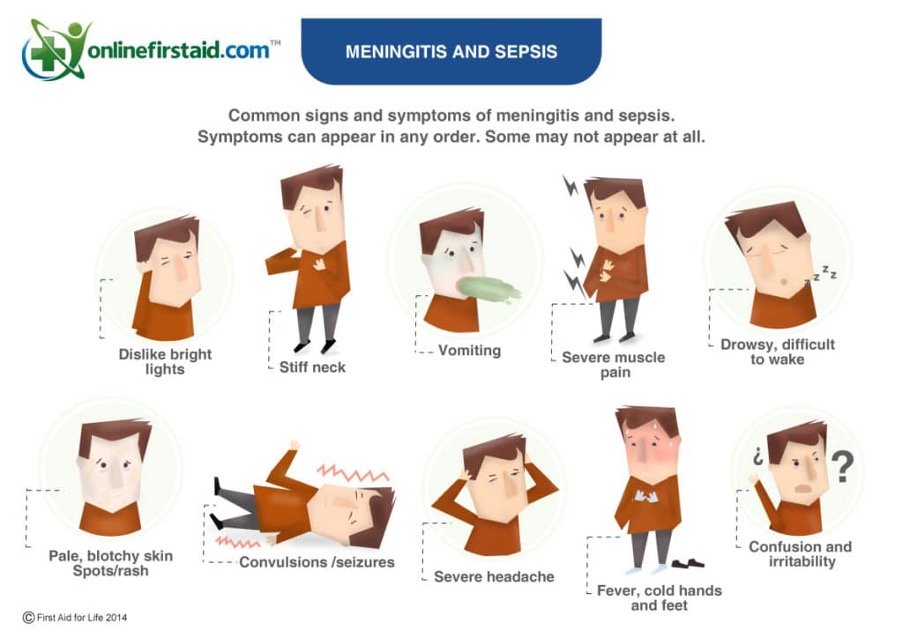
- Fever – particularly with cold hands and feet, a headache and feeling generally unwell
- Vomiting, diarrhoea and difficulty breathing
- Floppy, lifeless and drowsy
- A rash. This may not appear for all, but if someone is unwell and you see a rash which does not disappear when pressure is applied to it (the tumbler test) call an ambulance
These symptoms can appear in any order.
Babies and young children are at the most risk for meningitis. However, teenagers are the second most likely to succumb.
The following are symptoms specific to toddlers and babies:
- Pale, mottled skin
- Cold hands and feet
- Refusing to eat/ feed
- Irritable, not wanting to be held/ touched
- Body going stiff and making jerky movements, or becoming floppy and unable to stand up
- A tense or bulging soft spot on the head (fontanelle)
- High pitched moaning
Meningitis rash and the tumbler test
Most rashes disappear when you apply pressure to the skin. However, with meningitis, the rash behaves differently and remains visible when you press a clear glass tumbler over the skin (known as the tumbler test). Do not wait for a rash to appear as symptoms can appear in any order and some may not appear at all. The rash is often the very last to appear. It is vital to get help for meningitis early.
It can be harder to see a rash on dark skin. So be sure to check the soles of the feet, palms of hands, roof of mouth and inside eyelids.
Meningitis can kill in 4 hours: So trust your instincts and get help fast.
When to call an ambulance
- lf the casualty is getting worse and you are seriously concerned
- If they have a rash you are still able to see when you apply pressure with the side of a glass.
- If they are seriously unwell and have some of the above symptoms
Otherwise, call your GP. lf you cannot get to talk to the doctor immediately, get the casualty to hospital.
If you are sent home from the hospital or GP surgery and the child gets worse, go back. Trust your instincts and tell them you are worried!
Why are teenagers particularly at risk?
After young children, teenagers and young adults are among those most at risk of meningococcal disease. The bacteria are spread through close or prolonged contact, such as kissing or sharing drinks and vapes. Living closely with others in university accommodation can also increase the opportunity for the bacteria to spread.
Around one in four teenagers aged 15–19 carry meningococcal bacteria harmlessly in the back of their nose and throat, compared with approximately one in ten people across the general population. Most carriers do not become ill, but they can unknowingly pass the bacteria to others.
The 2026 MenB outbreak in Kent
The risks facing teenagers and students were highlighted by an unusually large outbreak of meningococcal group B disease in Canterbury in March 2026. The outbreak predominantly affected young people and was linked to students at the University of Kent and in the wider Canterbury area.
UKHSA identified 21 confirmed cases. Everyone affected required hospital treatment and, sadly, two people died. The outbreak prompted an extensive public health response, including preventative antibiotics and MenB vaccinations for thousands of students and other young people considered at increased risk.
Although outbreaks of this size are unusual, the incident demonstrates why students should remain alert to possible symptoms. Meningococcal disease can progress extremely quickly, and its early symptoms may be mistaken for flu, a hangover or another common illness.
Friends should look out for one another and regularly check anyone who goes to bed feeling unwell. Never wait for a rash to appear before seeking urgent medical help. Ensure everyone knows the symptoms to look out for.
The Kent outbreak, together with other recent cases and clusters, contributed to the introduction of a new, time-limited NHS MenB vaccination programme for young people at increased risk.
Who is eligible for the new MenB vaccine?
In England, the free, one-off MenB vaccination programme is available to three main groups:
- Young people born between 1 September 2007 and 31 August 2008. This is the Year 13 age group for the 2025–26 academic year. They are eligible whether or not they intend to continue into university or further education.
- Young people born on or after 21 July 2001 who are starting an undergraduate university course for the first time in autumn 2026. This includes eligible international students and students coming to England from Scotland, Wales, Northern Ireland, the Channel Islands or the Isle of Man.
- Young people born on or after 21 July 2001 who are entering further education for the first time in autumn 2026 and will be living in accommodation provided by an eligible residential further education setting.
Those who deferred their university place or took a gap year can still qualify, provided this will be their first time entering undergraduate higher education or residential further education in autumn 2026 and they meet the age requirements.
However, the programme does not generally cover postgraduate students, people who have already begun higher or further education and are simply changing course or institution, or other under-25s who do not fall within the Year 13 age group or first-time student criteria.
Eligibility and arrangements differ slightly across Scotland, Wales and Northern Ireland, so students outside England should consult their relevant national health service.
How and when can eligible young people receive it?
Eligible young people need two doses of the MenB vaccine, given at least 28 days apart, for the best protection.
The vaccine is available through participating community pharmacies. Eligible students may be asked to show evidence of their university or college place when attending their appointment.
First doses are available until 31 December 2026, while second doses can be given until 31 March 2027. Young people are encouraged to receive both doses as soon as possible and, where they can, before beginning university or moving into shared student accommodation.
The MenB vaccine protects against meningococcal group B disease. It is different from the MenACWY vaccine routinely offered during secondary school, so eligible young people should receive the new MenB vaccine even if they have already had MenACWY.
About us
Award-winning first aid training tailored to your needs – Please visit our site and learn more about our practical and online courses. In addition, it is vital to keep your skills current and refreshed.
We strongly advise that you attend a fully regulated Practical or Online First Aid course to understand what to do in a medical emergency. Please visit https://firstaidforlife.org.uk or call 0208 675 4036 for more information about our courses.
First Aid for Life is a multi-award-winning, fully regulated first aid training provider. Our trainers are highly experienced medical, health and emergency services professionals who will tailor the training to your needs. For instance we can provide courses for groups or individuals at our venue or yours.
First Aid for life provides information for guidance and it is not in any way a substitute for medical advice. First Aid for Life is not responsible or liable for any diagnosis made, or actions taken based on this information.



0 Comments